Sunday, August 28, 2011

Photos from our Gathering for Garden Educators, Day 1

Wyck is a Colonial-era house in the Germantown section of Philadelphia that has the oldest continually-tended rose garden in the New World.  Visitors can trace the history of rose gardening by walking through the garden, seeing what kinds of roses were popular at different times in our history. 
You can contact Wyck for visits and special events at http://www.wyck.org/ or at 215-848-1690


Nicole Juday is the landscape curator at Wyck Historic House and Garden, and she and Wyck's horticulturalist Elizabeth Belk took us on a terrific tour of the grounds.  Classes of all ages are invited to participate in hands-on activities and lessons and to tour the grounds and building to learn about life during the Colonial period.  There is also a working farm on the grounds and a Farmers Market every Friday from 2-6.  While we were there, a group from a nearby day care stopped by to see the chickens! 


Bee houses at Wyck. 
One thing we learned about while touring the Farm Camp at the Schuykill Center for Environmental Education the next day was how to make simple houses for native bees- just drill a series of holes in a narrow log or string together pieces of bamboo and hang the "bee house" from a tree limb.  Wyck's annual Honey Festival is Saturday, Sept. 10th.


Hansberry Garden and Nature Center is an amazing jewel in the heart of Germantown (Wayne and Hansberry Sts.).  Begun as a community garden, it now participates in City Harvest and provides environmental education to over 300 school students during the year.  David (pictured above) is one of the educators who teaches water testing to students of all ages at Hansberry and at area community centers.  Plans are underway for wheelchair-accessible beds, and area kids are encouraged to come garden in the summer. Contact the center by calling 215-438-7047.

We started the morning at Germantown Meeting's Old Tennis Court Community Garden, where each bed shows the particular interests and creativity of its owner.  These hardy folks first took up the asphalt from the tennis court, then prepared and planted beds, either raised or on straw bales or mounded.  What looked like an impossible task in the winter has turned into a verdant lot right on Wissahickon Ave.

Most impressive of all is the gardeners' creativity and hard work to deliver water to the garden.  This is their first water storage system.  Water is pumped up via a solar-powered pump from a well dug for this purpose.


Pictures from the Children's Garden at the Buffalo Botanical Gardens

 The front of the Buffalo Botanical Gardens. 
The conservatory is a large circle so you go from one environment to another.

 I love the welcoming message here, letting parents know it's OK for their kids to get actively involved.
 What fun.... something from nature that kids (and adults) might miss in a walk through a marsh.

 Don't know if you can see but plenty of birds came to the water as we sat quietly.  It's shallow enough so that all kids can wade too.
 Two "Touch Me" gardens full of fragrant herbs.
This was my personal favorite- two working pumps.  Hopefully these are easy and not too expensive to install as I could imagine how much our youngest students would love to play with the water.

Saturday, August 20, 2011

Children's Garden at the Buffalo Botanical Gardens

Yesterday, John and I toured the Buffalo Botanical Gardens- a REAL gem, with an around-the-world tour of exotic plants and the not-so-exotic.  A recent addition is the Children's Garden, created just out their back door.  Small and designed to let kids BE kids, it includes a large shallow water feature where kids (and birds) can play, a Touch Me garden of herbs, a raised bed where kids can plant and dig  up plants, compost bins, a butterfly garden and, my favorite, two pumps that actully work, mounted onto half barrels.  I could just imagine our PreK and K kids spending all their recess pumping water and letting it run through their fingers.

One problem was that it was almost all in sun, so I could see that kids wouldn't want to spend too much time outside in the very hot weather, but it had lots of feeders and we saw goldfinches, chickadees and a cardinal coming back and forth- all birds kids would easily spot!

An interesting piece of information about Buffalo-  It hosts the country's "largest flower show" each year.  Where, you might ask?  EVERYWHERE.  It's actually a tour of house gardens- scads of them all over the Buffalo area and the whole thing is FREE!  There was a wonderful photography exhibit of some of the gardens- just amazing.

As soon as we get home, I'll post the photos of the Children's Garden, now that Fern has shown me how.
Penny

Sunday, August 14, 2011

The High Line, NYC

As promised, here are some pictures John took of The High line in New York City last month.

The High Line is a park built on a former elevated freight rail line in the Meat Packing District on Manhattan's West Side.  Used to bring milk, meat, baking supplies and other goods into the city, it was called the "Lifeline of New York" when first established in the 1930's.

As rail traffic declined, the southernmost section was demolished and the remaining portion was left to go to seed.  In 1999 two neighborhood residents Robert Hammond and Joshua David founded the Friends of the High Line.  Taking 12 years, it is now a truly inner-city/above-the-city space, full of native plants and terrific walking/strolling/hiking for New Yorkers and visitors.

Here's the map of the High Line showing how it stretches from the corner of Gansevoort and Washington Streets in the Meat Packing District to 30th Street.
 
One of the many beautiful places to stop and chat or rest along the Line with panoramic views of the city scape.


Based upon a self-seeded landscape, the High Line contains a woodland, grassland, meadow and many planters highlighting native plants. 

There are several large seating areas along the High Line for people to gather. 
Bikes are not allowed, nor are roller blades.

Talk about walking among the tree tops! 
How about walking among the skyscrapers!

This makes me think of The Curious Garden by Peter Brown about a garden on an abandoned rail line that is found by a young boy who tends it and the garden grows and grows across the city until the whole city becomes a lush park.  John said the folks at The High Line said the book was not about the project, but I find that hard to believe!

Penny

Thursday, August 4, 2011

Teaching about Composting


Compost and composting are frequently included as an important element when creating gardens with children. 


We are learning about how to construct compost piles from various materials, 


and how to assess the various manufactured compost bins and tumblers on the market. 


We have seen many different methods and some of the problems with multiple users and varying conditions.


We know the 3 to 1 ratio of brown to green materials. We are learning about all the important bacteria, fungi, and macroinvertebrates that are so important for successful composting!


Take a look at this Cornell site:  http://compost.css.cornell.edu/microorg.html
We collected ideas about how to help kids understand the processes going on inside the pile, like having the children do jumping jacks to experience how their own body temperatures increase as they are active to connect with the by-product of heat in the compost pile!

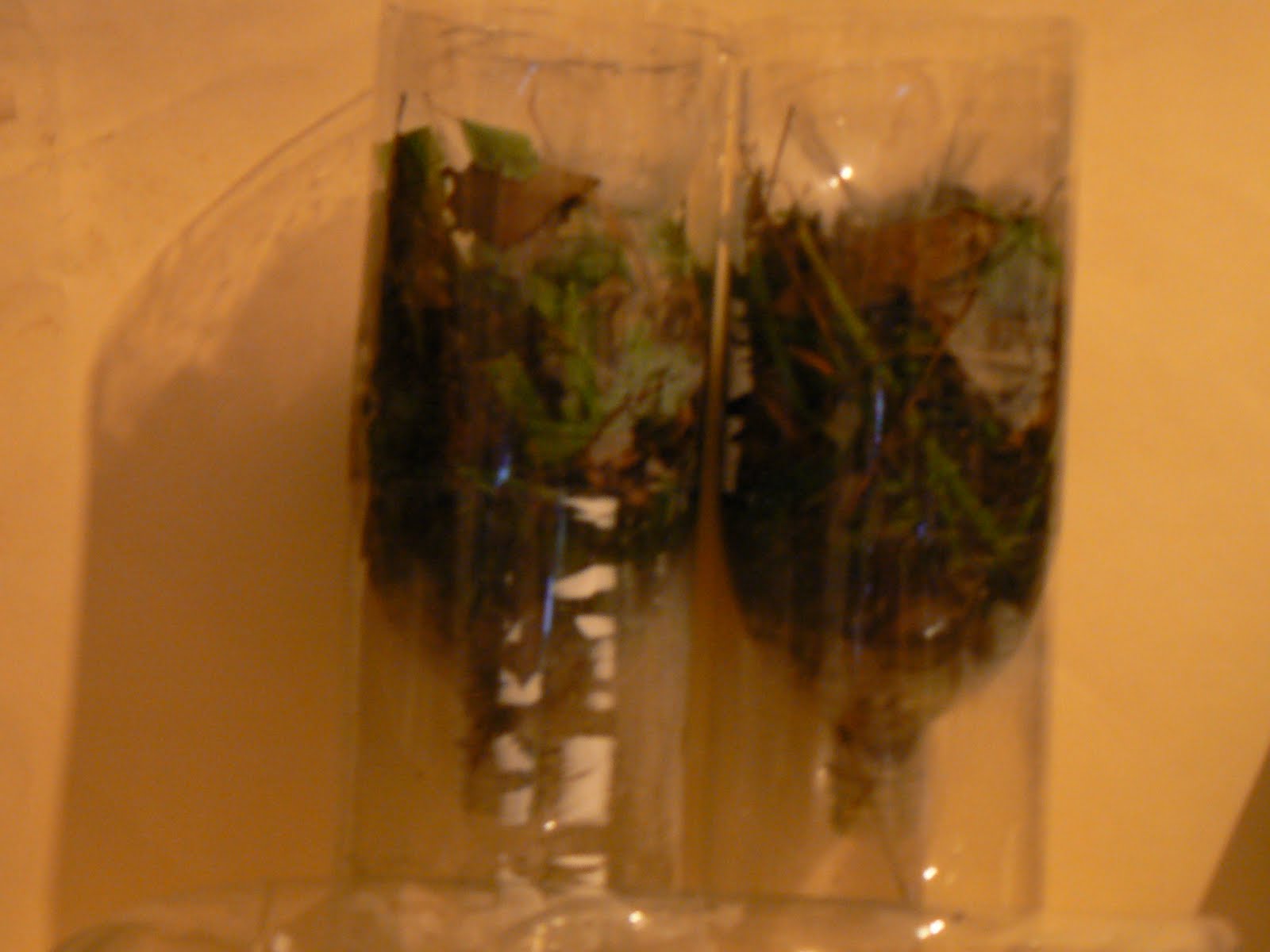
Today, in Day 3 of our Sharing Seminar, we made compost columns. These simple constructions are ideal ways for children to create their own mini-compost models!  All types of experiments can be created from this basic structure. The Bottle Biology Resources Network from the University of Wisconsin--Madison has lots of ideas for ways to use these columns.
Here is how we did it:


The columns are made from 2L plastic bottles with the labels removed, and bottles cut into two pieces. Each column requires one upper portion and two bottoms. Our bottles were already cleaned and cut for us (and probably should be cut for children as well.)  A filter paper, cheesecloth, or small square of netting is attached to the bottle opening with a rubber band so that when upended the composting material will not fall through.

We collected dried plant matter for our brown and weeded a bit around some of the plantings in the park to have our green stuff. The matter needs to be moist but not dripping wet. 


We placed layers of ripped up green plant matter, then shredded brown stuff, and a big spoonful of dirt in the upturned bottle with the covered opening, then repeated the layers again.


The second bottle bottom piece is then placed in the top of the column for a lid.


I hope these photos help to make the text clear....!

All photos except the first two are my own. The first two images came from a web article about composting on the web site:  "The Green Life"  http://www.thegreenlifeonline.org/garden_compost.html


Written by Fern


Saturday, July 23, 2011

Thank you Jane!

N is for Nasturtium

We came to MSU in East Lansing to attend the Symposium on Children and Youth Gardening. As I expected, I got to play and explore in the  4-H Children’s Garden on the MSU campus. Even in the blistering sunshine and later welcome rain, it was a glorious place to be!
chimes
green roof over outdoor classroom area

An unexpected highlight of this year’s AHS Symposium was the time I got to spend with Jane Taylor. She attended our presentation on Thursday morning, and we visited off and on throughout the almost four days. The symposium ended with Jane delivering the final keynote address. I learned so much from her and truly enjoyed her positive spirit, sense of humor, energy, and breadth of knowledge and understanding of children, plants, gardens and their joyful intersection! In 2003 she closed her AHS Symposium speech with: 

In this next century it's an unbeatable combination -- children connecting with the natural world through garden-based activities by interacting with living plants and then connecting to AHS resources via computer technology. The simple early aims are still the same-to create gardens to open children's minds, to touch their hearts and souls, and to let imagination's soar while teaching them the basic principles of gardening and science using the common things and fun experiences in their environment.

Today in her closing speech she took a different approach. She taught us of the great role that MSU (and its teachers) has played down through the years. As the first land grant college (beating Penn State by a few months.... They’re a Big 10 rival now...) in the US, Michigan Agricultural College became the incredible institution that we know today as Michigan State University. William James Beal was one of the group of 6 professors here at its beginnings. Along with all his many teaching responsibilities, he created what is now the oldest continuously operating botanical garden. He had Liberty Hyde Bailey as one of his students, a botanist who is considered along with Anna Botsford Comstock to have founded the Nature Study movement. These are two of my early heroes, but I learned today of how L.H.Bailey also helped create the federal laws that founded the Ag Extension system and our current 4-H clubs! As she closed her speech today, Jane congratulated and thanked the future teachers, scientists and gardeners who will continue this important work. It was a fine and optimistic closing to a great symposium.

Jane Taylor played a major part in this ongoing lineage, herself. She  helped to design and install the first real children’s garden. Yes, the one here in East Lansing. Prior to this garden in 1993, children visiting gardens were requested, cajoled and scolded to be careful and certainly not to play on the sculptures!   (Kind of like how we had to call the Philadelphia Museum of Art the “Please Don’t Touch Museum” for my boys.)
Here though at the 4-H Children’s Garden, kids are invited to explore, to use their bodies and minds together, to climb, jump, and hide as they learn about the world of plants and nature. Many similarly active gardens have been formed since then, often in consultation with Jane. I look forward to traveling and finding as many of them as I can in the years ahead!
Thank you Jane! 


Written by Fern

New wonderful gardening blogger!

Greetings from the AHS Symposium on Children and Gardening!

One of the many wonderful outcomes of attending this conference is that we get to meet so many folks doing terrific things in the garden with kids. Today, for example, I attended a workshop led by Shannon Hardwicke from an elementary school in Sacramento, CA.  Shannon is the science and environmental coordinator for this school and described the incredible array of programs she's introduced into her community.  Every week each class (PreK-6th) divides into two groups, with one group having science in the science lab with their teacher while the other half goes to the garden.  There, they have a lesson and then do "garden chores" with the help of parent volunteers whom Shannon trains.  Shannon's created a Green Team of kids, who oversee the recycling program (they compost and recycle almost everything) and who provide leadership for green concerns in the school.  Just this year, the Team made presentations to the school superintendent about the various ways their school could go greener, with the result that a school slated for closure is now identified as the vanguard school for greening!  In addition, she's created a school garden for play, a butterfly house and a kitchen garden, all using parents and kids as labor!  She's one of those folks who has a real can-do attitude and doesn't give up but keeps on pluggin' away.

Here's an article from the local Scaramneto newspaper about the program:

http://www.valcomnews.com/?p=4515


Our suite-mate for the conference was Debbie Kong, a (young) Master Gardener from Chicago, IL.  Among other things, Debbie blogs with two other home gardeners and shares the most interesting and motivating information!  Please give her blog a read.... she has such interesting and low-cost ways to grow food and is another one of those can-do people.  Debbie's background is design, so her gardens are much tidier than mine and she grows the most interesting range of veggies.  You can get to her blog at http://www.greenroofgrowers.blogspot.com/.  Debbie's a big fan of using 5 gallon plastic buckets to make SIP's- Sub-irrigated Planter- very similar to (and much cheaper than) what we know as an Earth Box.  Debbie's posted a video of how to put these together.  She also introduced me to Winter Sowing, using a milk jug.  But, more on that later, when this horrible heat has passed!